About
Personal development. Personal growth. Self-development. The New Age. Self-help.
Some use these terms interchangeably, while others see them as describing radically different things. Although there's a less than clear understanding of exactly what personal growth is, even among its teachers and critics, one thing that's clear is that it is coming under attack.
In recent years, several books, and many articles, have been sharply critical of various facets of personal growth. Thus far, personal development's critics--to my knowledge--have largely gone unanswered.
Maybe this is because personal growth is such a vast and amorphous field, and it's difficult for any individual teacher or student to understand whether the critiques out there are aimed at them. Maybe personal growth teachers see their ideas as so widely accepted that no defense is necessary. Maybe people involved in personal growth have generally achieved so much inner peace that the critics don't bother them.
Whatever the reason, we've seen no public response to the critics as of yet, and the purpose of DevInContext (Development In Context) is to change that. I think many of the personal growth ideas and techniques out there have much to offer us, and I want to encourage people to avoid hastily dismissing them as woo-woo, flaky, or [insert your derisive term of choice].
Personal growth's opponents tend to emphasize the value of critical thinking, and say that as a culture we have been too willing to swallow personal growth ideas without examination. I agree that critical thinking is important, and I think it should be applied evenhandedly -- both to personal growth's proponents and to its critics.
What I Mean To Do (And Not Do)
Here at DevInContext, I intend to, among other things:
1. Offer a definition of personal growth to bring some clarity to this debate.
2. Challenge many of the critics' common assumptions.
3. Make a compelling case for the value of many personal growth ideas.
One thing I won't do is try to describe or defend every teacher and school of personal growth out there. That task, given the size of the field, would be impossible in one lifetime. It would also be unnecessary to a defense of personal growth ideas, generally speaking.
After all, I wouldn't have to show that, say, every philosopher in existence has had valuable ideas in order to show that philosophy, on balance, has been valuable to the world. By the same token, I don't need to prove that every single self-help book out there is valuable to argue for the value of self-help, or prove that every single self-development workshop has benefited its participants to prove the benefits of those workshops.
Thus, this blog will be more about ideas and perspectives than individual people or news stories.
About Me
My name is Chris. I am the author of Inner Productivity: A Mindful Path to Efficiency and Enjoyment in Your Work and many magazine and blog articles, and I coach people in finding productivity and satisfaction in what they do from a mindful perspective. I'm also an attorney and musician. I've spent quite a while in the field of personal growth, both as what we might call a "student" and a "teacher." If I do say so myself, I think my background puts me in an ideal position to think about and comment on these issues.
I'm looking forward to talking with you.
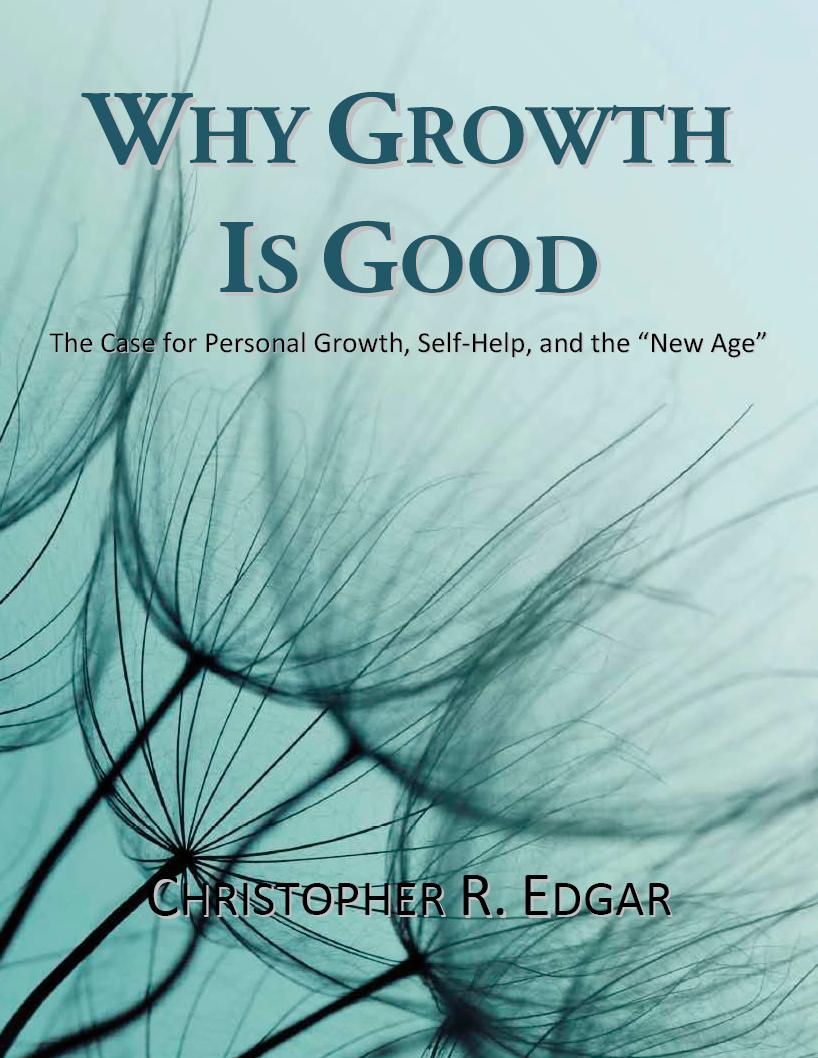
E-Book: Why Growth Is Good
Most Popular Posts
-
Thoughts on the Mankind Project Lawsuit
Personal Development Politics, Part 2: The Elections and Self-Responsibility
Regulating Self-Help, Part 2: What Is a Benefit?
Rainbow Right-Wingers, and Other Myths About Personal Development Politics
Authenticity Answers, Part 1: How Deep Is Your Want?
